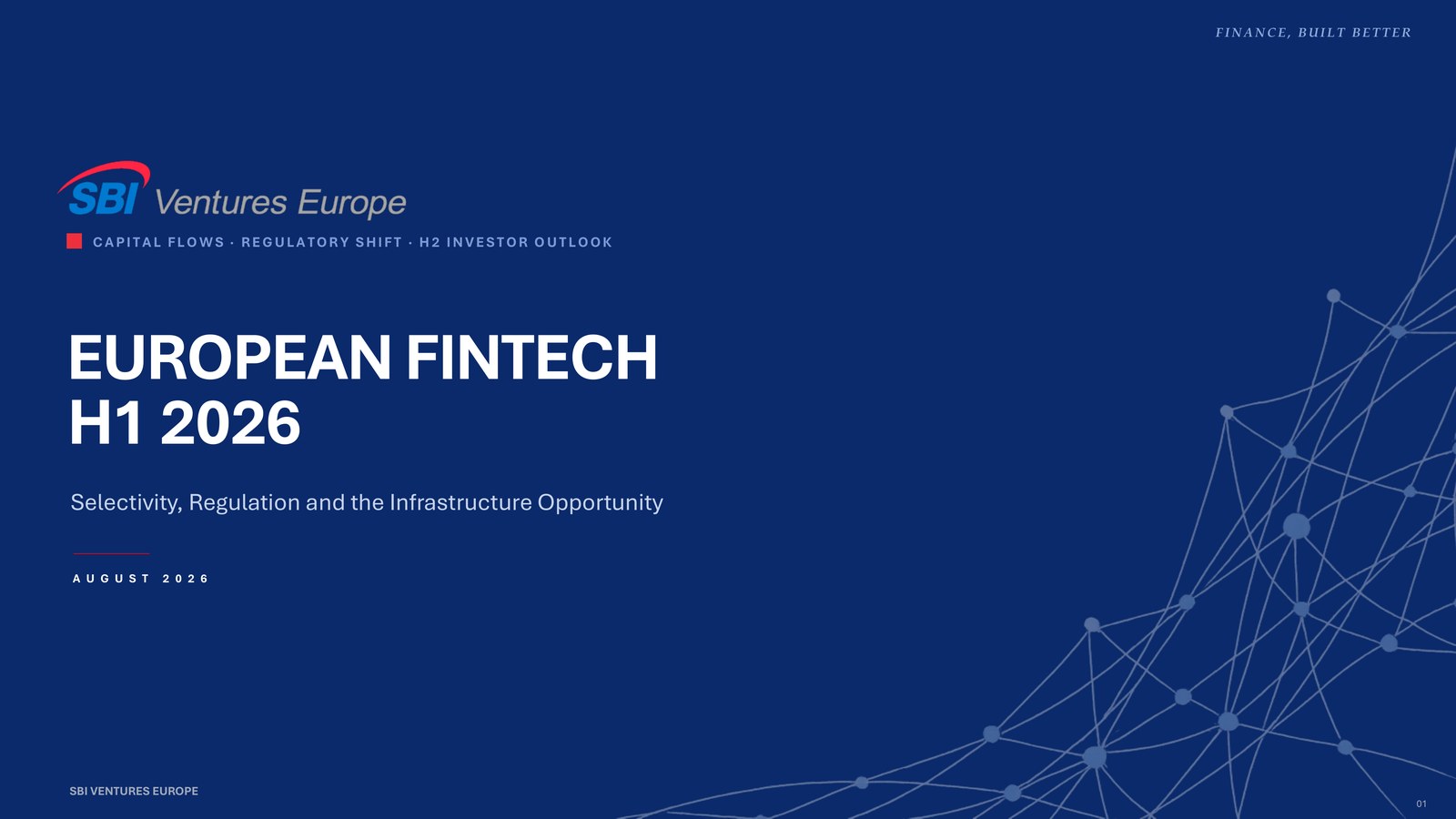
Fewer deals, more capital: our European Fintech H1 2026 report is out

European Fintech H1 2026

Selectivity, Regulation and the Infrastructure Opportunity
By Renxiu Zhao Published 5 August 2026 47 pages

European fintech stayed active in the first half of 2026, but capital did not return broadly. Deal count fell 36% while disclosed funding rose 21% — a quality filter, not a recovery. This report sets out where capital actually went, which regulatory deadlines are creating non-optional demand, and where we think the opportunity sits in the second half of the year.

Download the report (PDF)
Free · No registration required
European Fintech H1 2026 — report cover
383fintech deals closed in H1 2026, down 36% year on year
$5.74Bdisclosed capital deployed, up 21% despite fewer deals
61%of deals were early-stage — formation stayed healthy
931fintechs classified for the AI capability study

What we found

Three findings shaped how we are approaching the second half of the year.

01

Selectivity, not recovery

Deal count fell 36% (598 → 383) while disclosed capital rose 21% ($4.76B → $5.74B) and the median round grew 40%, from $3.0M to $4.2M. Early-stage formation held up; the Series A/B bridge tightened. The market is concentrating into fewer, larger bets rather than broadly reopening.

Fewer companies raised — but selected assets cleared larger rounds.
02

Regulation is now the European edge

Twelve EU regimes carry binding dates through 2029. MiCA has been live since 1 July 2026, the single AML rulebook binds 10 July 2027, the AI Act's credit and insurance-pricing duties bind 2 December 2027, and covered firms must accept the state identity wallet by 24 December 2027. Each creates dated, budgeted, non-optional demand for compliant infrastructure.

Europe does not beat the US on breadth. It wins where regulation creates non-optional infrastructure demand.
03

The AI credibility gap

We read the product and developer documentation of 931 fintechs and classified each against IBM's definitions of agents and assistants. 84 companies describe themselves as agents; 5 meet the definition. In the other direction, 481 ship a working AI product but 309 of them never say the word. Building AI is more common than talking about it — and calling yourself an agent is 17 times more common than being one.

Underwrite AI as workflow ROI, not as a label.

What's inside

Seven sections, plus methodology.

01
Executive SummaryH1 2026 in one view
02
Deal Activity & Competitive LandscapeStage mix, capital concentration, who is funding European fintech
03
Geography MomentumRegional champions and a sourcing playbook by stage and thesis
04
Sector Deep DivesPayments, digital assets, regtech and the SME/CFO stack
05
Regulatory CatalystsTwelve EU regimes, their binding dates, and what each one changes
06
AI Trend & Reality Check931 companies classified; what actually ships versus what is claimed
07
Investment OutlookVertical attractiveness ranking and our no-go areas for H2
08
AppendixFull methodology for the deal dataset and the AI classification

How this was built

The deal dataset is a single PitchBook pull per half-year, run identically across H1 2025 and H1 2026, then classified through a rulebook, a language model and a human audit of every low-confidence call. The AI study classified 931 companies against published definitions, with an independent second reader re-labelling a fresh sample from scratch.

Every regulatory date in the report traces to the legal text itself. Where a source could not be verified, the claim is flagged rather than published.

931companies classified
83%independent re-read agreement
12EU regimes analysed from primary law

About the author

Acknowledgements. This report is sharper for the perspective, commentary and challenge of Shotaro Iwano, Andrea Böhmert and Moritz Schwarz at SBI Ventures Europe, and of Dr. Matthias Heinrich at Solaris. Thanks also to Mateo Rojas for research support during his summer internship, particularly on the regulatory catalysts, AI trends and sector deep dives.

Building in regulated financial infrastructure?

We invest in the rails, platforms and compliance infrastructure underneath European finance. If that is what you are building, we would like to hear from you.

Get in touch

Sources: PitchBook H1 2025 and H1 2026 venture deal data; EUR-Lex primary legislation; ESMA, EBA and ECB public registers. Figures reflect disclosed rounds only. This report is provided for information purposes and does not constitute investment advice.

Sign up to our Newsletters

Thank you! Your submission has been received!
Oops! Something went wrong while submitting the form.

Address

Address
SBI Ventures Europe GmbH
c/o Solaris SE,
Cuvrystrasse 53, 10997 Berlin, Germany

Email Us
info.europe@sbigroup.co.jp

Email Us

Home Type
Digital banking platform.
More Info
Social trading and investing platform.
More Info
Embedded finance solutions.
More Info
AI-powered personal finance assistant.
More Info
Digital business banking.
More Info
Fintech marketplace.
More Info
Digital asset trading built for institution
More Info
Cryptocurrency compliance and risk management.
More Info
Identity verification and authentication.
More Info
Open banking platform.
More Info
Buy-now-pay-later platform.
More Info
International payment solution
More Info
Digital mortgage broker.
More Info
Insurtech company.
More Info
Cryptocurrency wallet and payment platform.
More Info
Core banking software for microfinance.
More Info
Fintech company builder.
More Info
Marketplace for CNC parts
More Info
Drones for industrial inspections
More Info
Open credit network for on-chain lending.
More Info
Robotic automation software
More Info
Metal Component Innovation
More Info
Thermal energy storage
More Info
Heavy machine data & analytics
More Info
Next generation chemical manufacturer
IoT cyber security
More Info
No listings found. Try editing your filters for best results.
Reset
Thank you! Your submission has been received!
Oops! Something went wrong while submitting the form.
Update cookies preferences